MCP Setup
TL;DR
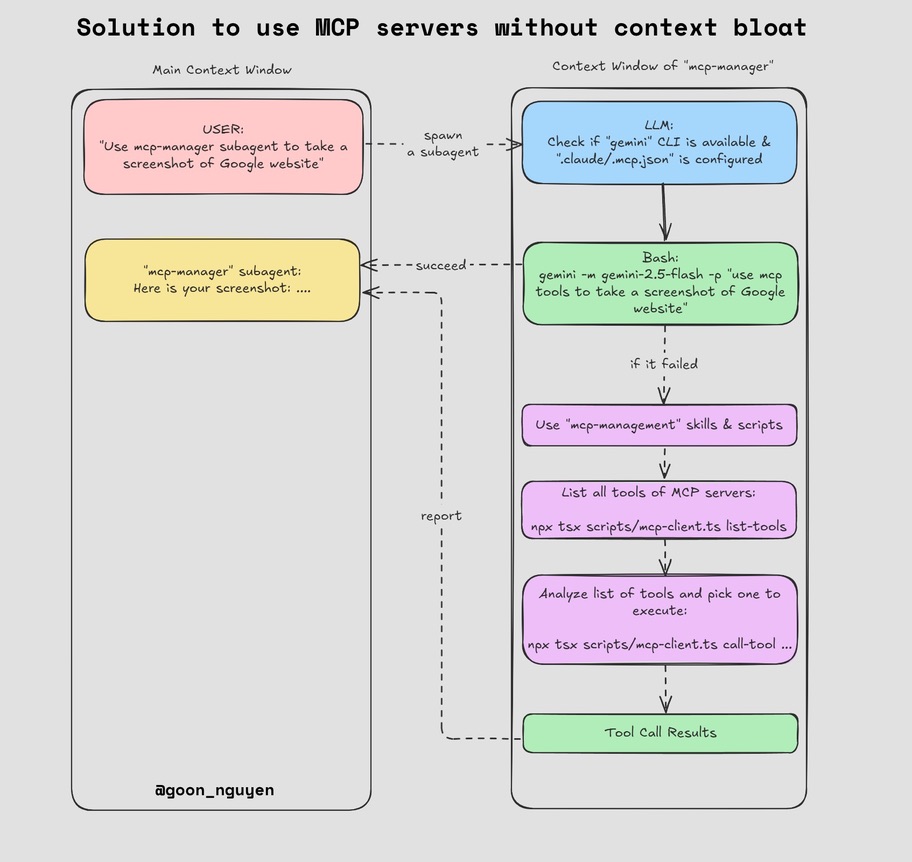
ClaudeKit delegates MCP (Model Context Protocol) servers to the dedicated mcp-manager subagent. This isolates heavy tool manifests away from the primary agent, keeping its context window lean while still enabling deep integrations.
Setup Checklist
- Copy the template config
cp .claude/.mcp.json.example .claude/.mcp.json - Customize the MCP roster
- Remove the default sample servers:
context7,human-mcp,chrome-devtools,sequential-thinking. - Add only the MCP servers you truly need to avoid unnecessary token use.
- Remove the default sample servers:
- Save the configuration so the subagent can bootstrap clients from
.claude/.mcp.jsonon demand.
💡 Keep
.claude/.mcp.jsonoutside your main prompts so the core agent never loads server manifests unless explicitly requested.
Using MCP Tools
Trigger the subagent-managed tools via the /use-mcp command:
/use-mcp <instruction>Example
/use-mcp Use chrome-devtools mcp to capture a screenshot of google.comClaudeKit will summon the mcp-manager subagent, load the configured MCP clients, analyze available tools, execute the best fit, and return the results to your primary chat.
Technical Deep Dive
Why This Architecture?
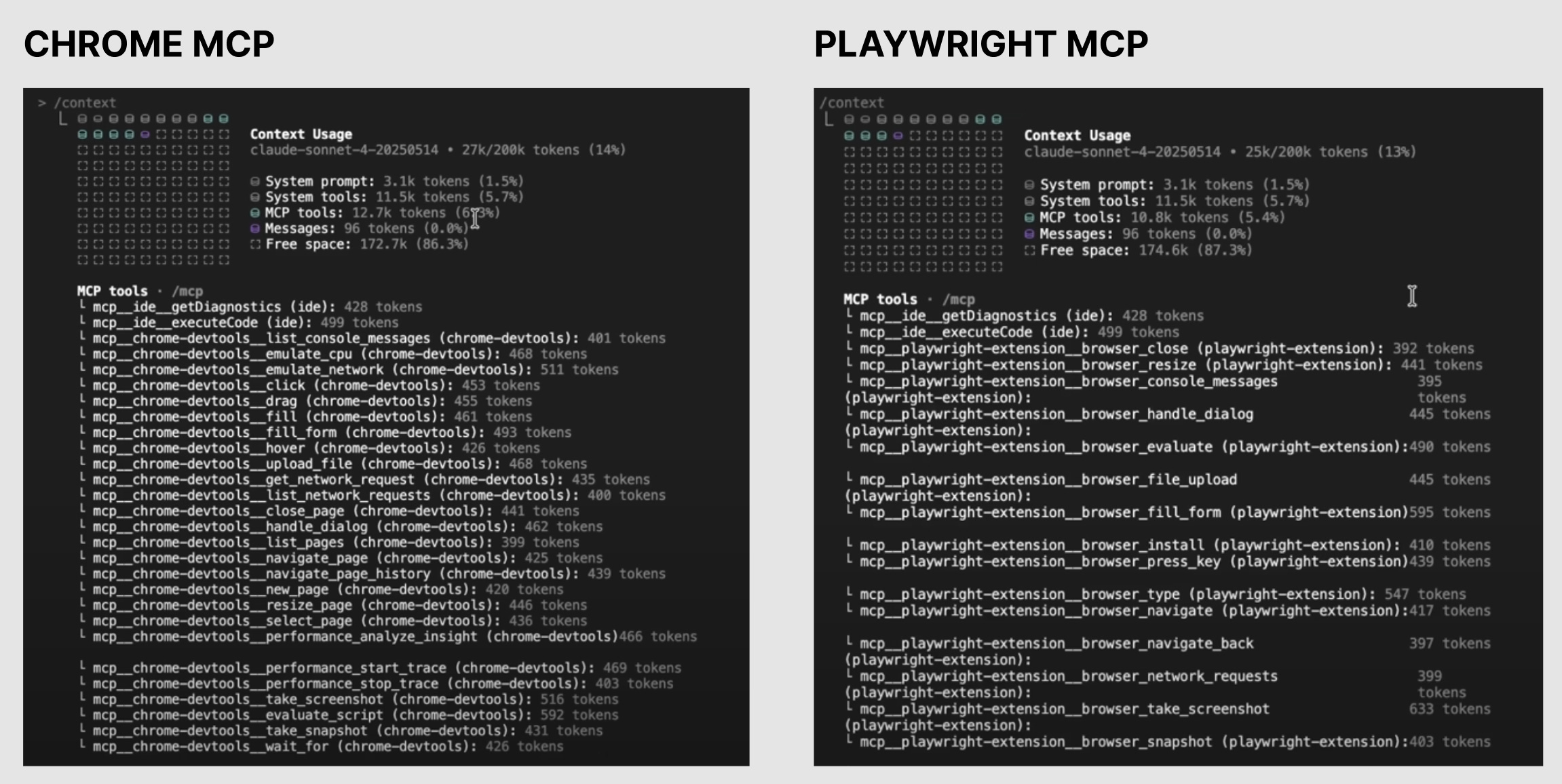
Anthropic’s “Code Execution with MCP” pattern inspired a lightweight approach: subagents have their own context windows. Loading MCP manifests directly into the main agent quickly bloats its context—especially with tool-heavy servers like Chrome DevTools or Playwright. By shifting those manifests into a subagent, the primary conversation stays clean even if dozens of MCP servers are configured.
How It Works
- The mcp-management skill bundle stores script snippets that instantiate MCP clients from
.claude/.mcp.json. - The mcp-manager subagent is granted these skills and remains dormant until a
/use-mcpcommand fires. - When invoked, the subagent:
- Loads
.claude/.mcp.json. - Connects to the declared MCP servers.
- Enumerates available tools and selects the best option for the prompt.
- Executes the tool invocation and streams the response back to the main agent.
- Loads
The result: your main context stays pristine, yet you can still tap into specialized MCP capabilities. (Yes, the joke still stands—you could register 80 MCP servers, but please add only what you really need.)
Further Optimization
Even with subagent isolation, processing massive MCP catalogs still burns tokens. To mitigate that, ClaudeKit can hand off heavy MCP orchestration to gemini-cli, shifting the most expensive reasoning to a cheaper, external runtime while keeping the main conversation focused.
Next Steps
- Keep refining
.claude/.mcp.jsonas your toolset evolves. - Version-control the file privately if it includes API endpoints or sensitive details.
- Pair
/use-mcpwith automation commands (e.g.,/cook,/fix,/plan) to mix bespoke tools with ClaudeKit’s native agents.
With this workflow, you get the power of MCP without the usual context penalty.